
Compressed Air Foam Fire Suppression Systems: Key Applications in Industrial Fire Protection

Fire protection in high-risk industrial facilities presents challenges that standard municipal or water-only fire suppression methods often cannot adequately address. In environments characterized by high-value equipment, flammable liquid storage, power generation assets, battery energy storage systems (BESS), heavy transport vehicles, or confined infrastructure, a fire event can escalate within seconds. Such incidents threaten catastrophic asset loss, prolonged operational downtime, severe environmental contamination, and risk to personnel.
To mitigate these severe risks, specialized engineering solutions are required. Among these, the compressed air foam fire suppression system has emerged as an effective, highly adaptable technology for targeted high-hazard fire protection scenarios. By combining water, foam concentrate, and compressed gas prior to discharge, compressed air foam systems (CAFS) produce a uniform, high-energy foam matrix capable of rapid flame knockdown, surface adherence, and thermal insulation.
However, a compressed air foam fire suppression system is not a universal replacement for every traditional fire suppression method. Industrial fire protection requires a rigorous match between the suppression medium, the specific fuel type, environmental conditions, regulatory requirements, and asset sensitivity. This guide provides an engineering-oriented analysis of compressed air foam fire suppression applications, system mechanics, operational limits, project selection parameters, and key considerations when choosing an application-specific fire safety partner.
What Is a Compressed Air Foam Fire Suppression System?
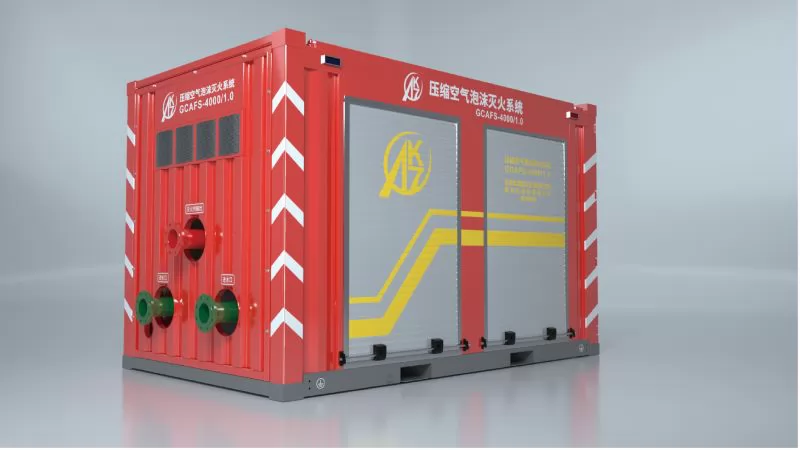
To evaluate the engineering role of a compressed air foam system (CAFS), it is essential to first understand its underlying thermodynamic and mechanical operating principles. Unlike conventional passive or aspirated foam systems, a compressed air foam fire suppression system relies on mechanical energy supplied by compressed gas—typically dry compressed air or nitrogen—to actively generate and expand foam within the piping network prior to discharge.
How CAFS Generates and Discharges Foam
The core principle of CAFS is pre-discharge aeration under energy. In a traditional air-aspirating foam system, a premixed solution of water and foam concentrate is forced through a specialized nozzle where atmospheric air is drawn into the stream via the Venturi effect. This method relies heavily on discharge velocity and nozzle geometry, often resulting in inconsistent bubble structures and energy loss over distance.
In contrast, a compressed air foam fire suppression system introduces pressurized air directly into the liquid foam solution within a mixing chamber upstream of the discharge outlet. Because the air is injected under pressure (typically 0.6 to 1.0 MPa), the resulting mixture undergoes turbulent agitation that thoroughly homogenizes the liquid and gas phases. This process forms millions of uniform micro-bubbles filled with compressed gas. When the foam exits the nozzle or discharge outlet, the stored pneumatic energy propels the expanded foam matrix over significant distances with high kinetic velocity, precise stream integrity, and reduced pressure drop across piping runs.
Main Components of a CAFS
A fully integrated industrial compressed air foam fire suppression system comprises several critical subsystems working in synchronized sequence:
- Water Supply Infrastructure: A reliable water source providing required volumetric flow rate and static pressure, sourced from dedicated fire water tanks, high-pressure pumps, or pressurized vessels.
- Foam Concentrate Storage and Proportioning: A storage tank containing appropriate foam concentrates (such as Fluorine-Free Foams [F3], AFFF, or alcohol-resistant concentrates [AR-AFFF]) coupled with an automated proportioning mechanism maintaining precise concentrate ratios (typically 1%, 3%, or 6%).
- Compressed Air / Gas Source: High-pressure compressed air banks, dedicated air compressors with accumulator vessels, or high-pressure nitrogen cylinders engineered to supply stable gas volume and pressure during the entire suppression sequence.
- Mixing Manifold / Proportioning Unit: The central mechanical chamber where the water-foam solution meets the compressed air stream under controlled flow rates and pressure balances.
- Distribution Piping and Control Valves: Corrosion-resistant piping networks, manifold assemblies, and fast-acting automated actuation valves connected to a central fire alarm and control panel.
- Discharge Devices: Application-engineered nozzles, monitors, foam makers, or open discharge heads configured to deliver specific expansion ratios and spray patterns tailored to the target hazard.
How Foam Expansion Influences Fire Suppression
The performance of a compressed air foam fire suppression system depends heavily on the foam expansion ratio and drainage time, which dictate how the agent interacts with burning fuel and hot surfaces:
- Low-Expansion CAF (up to 20:1): Produces a denser, fluid foam with superior throw distance and penetrative capabilities. Low-expansion CAF flows readily across fuel liquid surfaces and penetrates deep into Class A materials or complex structural geometries.
- Medium-Expansion CAF (20:1 to 100:1): Yields a lighter, highly cohesive foam blanket optimized for rapid volumetric filling, surface adherence on vertical structures, and three-dimensional vapor suppression on flammable liquid spills.
- High-Expansion CAF (above 100:1): Primarily used for total flooding of enclosed spaces, such as cable tunnels, turbine halls, or hazardous storage vaults, displacing oxygen while providing cooling.
The micro-bubble stability inherent to compressed air foam increases drainage time—the rate at which liquid drains from the foam blanket. Longer drainage times ensure that a continuous moisture layer remains suspended above hot surfaces, enhancing radiant heat shielding and preventing re-ignition.
Why CAFS Can Be Valuable for Industrial Fire Protection
Understanding the distinct operational capabilities of compressed air foam fire suppression systems allows fire protection engineers and facility operators to deploy them effectively where traditional water or gas systems exhibit limitations.
Rapid Application and Fire Control
The primary benefit of a high-energy compressed air foam system is its ability to deliver rapid flame knockdown. When discharged onto a Class A or Class B fire, the dense foam blanket acts simultaneously through four core mechanisms:
- Suffocation (Oxygen Exclusion): The stable foam layer forms a continuous physical barrier over liquid fuel or solid combustibles, cutting off the oxygen supply required to sustain combustion.
- Vapor Suppression: On hydrocarbon and polar-solvent liquid fires, the cohesive foam blanket seals volatile fuel vapors beneath the surface, preventing explosive fuel-air mixtures from forming above the hazard.
- Cooling: The high water content retained within uniform bubble walls absorbs latent heat from hot surfaces, rapidly reducing temperatures below auto-ignition thresholds.
- Radiant Heat Shielding: The reflective structure of the expanded foam reflects radiant thermal energy away from unburned fuel and adjacent structural steel, inhibiting fire spread.
Foam Coverage and Surface Protection
Standard water streams suffer from high surface tension and runoff; up to 80–90% of applied water can run off target surfaces without absorbing significant thermal energy. Compressed air foam exhibits low surface tension and high viscosity. When applied to vertical, overhead, or complex equipment surfaces—such as transformer casings, structural steel, or vehicle chassis—the foam adheres to the target rather than dripping off immediately. This prolonged contact time maximizes thermal transfer and provides a persistent insulating barrier against external flame impingement.
Water and Agent Efficiency
In remote or resource-constrained industrial settings, securing massive water supplies is often economically or logistically impractical. A compressed air foam fire suppression system requires significantly less water and foam concentrate—frequently reducing water consumption by 50% to 80% compared to traditional deluge water spray or standard foam-water deluge systems. By optimizing the water-to-air ratio, CAFS achieves equivalent or superior fire suppression performance with a smaller liquid footprint, drastically lowering tank storage capacity, pipe sizing, and wastewater containment requirements.
Flexibility in Fixed and Mobile Applications
Compressed air foam technology transitions seamlessly across deployment formats:
- Fixed Systems: Automated systems integrated with early detection networks to protect enclosed or fixed equipment zones.
- Semi-Fixed / Hose-Reel Stations: Manual or semi-automated response units positioned within process plants, allowing site personnel to deliver heavy foam streams instantly.
- Mobile Response Vehicles & Skid Systems: Compact, self-contained trailer units, truck-mounted skids, or emergency rescue vehicles designed for rapid off-road deployment.
Limitations and Application Boundaries
Despite its operational strengths, a compressed air foam fire suppression system is not a universal solution for all industrial fire hazards. Responsible fire safety engineering requires recognizing these clear application boundaries:
- Energized Electrical Hazards (Class C): While foam drainage leaves minimal free water, wet foam streams are electrically conductive. CAFS should not be discharged directly onto live high-voltage electrical equipment unless power isolation is automatically confirmed prior to discharge, or distance clearance criteria are strictly maintained.
- Maintenance and Gas Supply Dependency: CAFS relies on active mechanical components, including pressurized gas cylinders or air compressors. Air pressure loss, valve failure, or incorrect proportioning directly degrades foam quality.
- Complex Piping Design Constraints: Transporting two-phase fluids (foam solution mixed with compressed gas) requires precise hydraulic calculation. Excessive pipe lengths, sharp bends, or improper pipe sizing can cause phase separation ("slugging"), leading to uneven discharge.
- Freezing Environments: Fixed wet-pipe CAFS lines require heat tracing or dry-pipe configurations when installed in sub-zero industrial environments to prevent agent freezing within lines.
Where Are Compressed Air Foam Fire Suppression Systems Used?
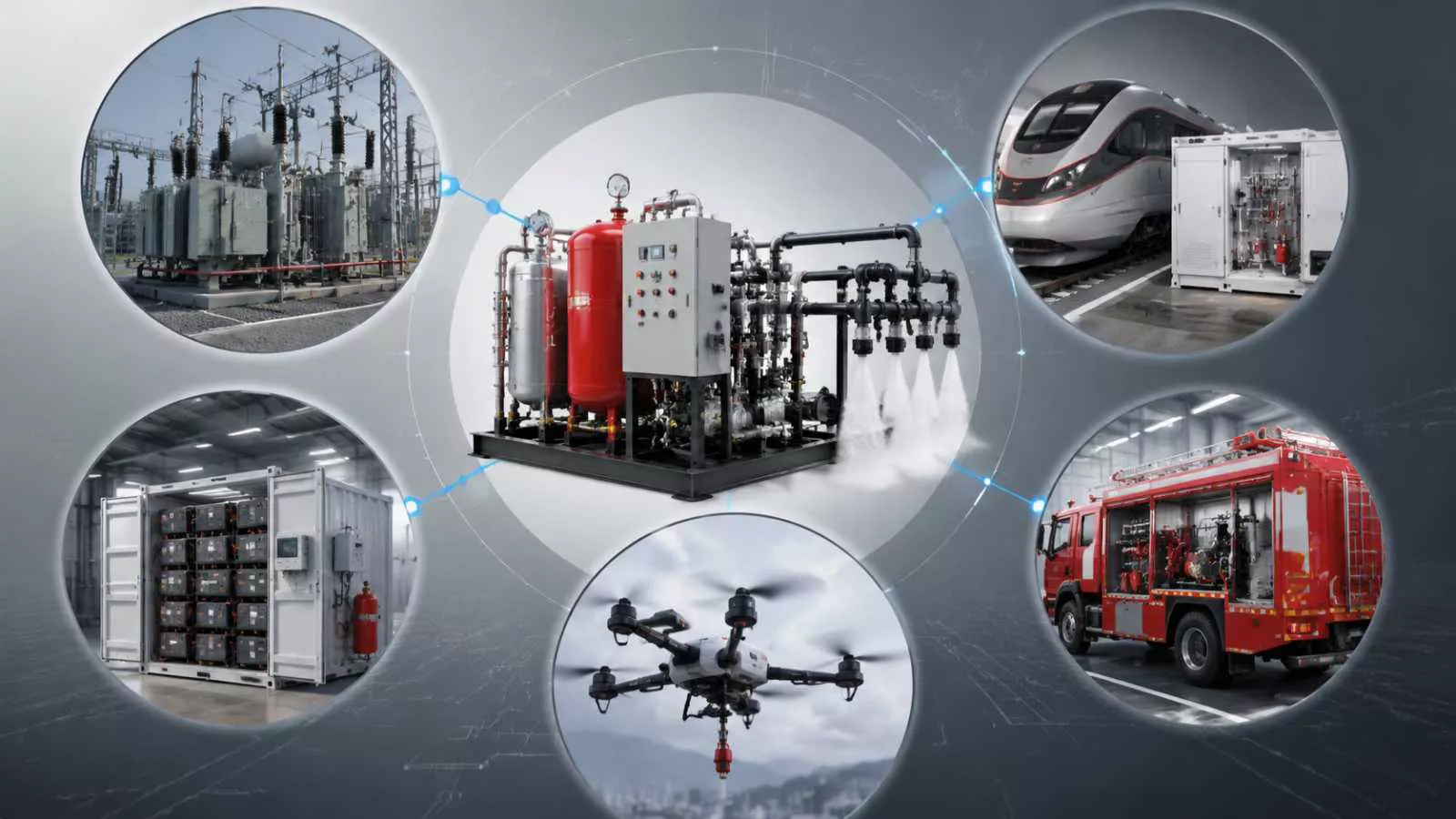
The technical attributes of CAFS make it particularly suitable for challenging, high-value industrial environments. Below is a detailed review of core application sectors where application-specific compressed air foam fire suppression systems are increasingly specified.
Power Grid and Transformer Fire Protection
Electrical substations and power transmission networks contain high-value oil-immersed transformers, reactor units, and oil-filled circuit breakers. A major failure—such as internal arc breakdown or bushing rupture—can ignite hundreds or thousands of liters of combustible transformer dielectric oil, resulting in severe pool fires, cascading thermal damage to adjacent phases, and long-term regional power outages.
Traditional transformer protection relies heavily on water deluge spray systems. However, water spray requires immense water volume, massive drainage pits, and oil-water separation basins. Furthermore, water alone can cause thermal shock to structural components without rapidly extinguishing heavy oil pool fires.
In oil-immersed transformer applications, a dedicated compressed air foam fire suppression system provides critical performance advantages:
- Thermal Insulation & Rapid Cooling: The expanded foam clings directly to hot metal radiator fins and tank walls, insulating surrounding infrastructure while suppressing oil surface flames.
- Oil Vapor Sealing: High-energy foam rapidly seals burning transformer oil, eliminating toxic smoke production and preventing fire spread to cable trenches.
- Water Consumption Reduction: CAFS operates effectively with a fraction of the water volume required by traditional deluge systems, greatly simplifying site environmental containment and civil engineering costs.
In electrical grid fire safety engineering, solutions must be custom-tailored to site geometry, voltage clearances, and rapid automatic detection interfaces. For instance, JUAND's Fire Safety of Power Grid solutions demonstrate how specialized engineering integrates high-speed thermal detection, automated power isolation interlocks, and optimized CAFS distribution manifolds to protect critical substation assets against catastrophic transformer fire events.
Transportation and Vehicle Fire Safety
Transportation infrastructure—ranging from heavy off-road mining vehicles, railway locomotives, commercial bus fleets, and tunnel transit systems to specialized marine vessels—operates in tight, vibration-heavy, and environmentally harsh conditions. Vehicle engine compartments and enclosed mechanical bays house pressurized hydraulic oil lines, fuel lines, hot turbochargers, and electrical harnesses in extremely compact configurations.
When a hydraulic line ruptures near a hot exhaust manifold, an engine bay fire can consume a vehicle within minutes. Fixed vehicular fire suppression demands compact equipment footprint, rapid localized suppression into enclosed voids, and resilience against continuous mechanical vibration and temperature swings.
A specialized compressed air foam fire suppression system designed for transport applications uses self-contained, pre-pressurized vessels or gas-generator cartridges. Upon activation by linear heat detection or flame sensors, the system discharges expanded foam through targeted distribution nozzles. The foam fills the complex geometrical voids of the engine bay, blanketing hot block components and cutting off air supply despite turbulent airflow within the engine compartment.
Through its Fire Safety of Transportation portfolio, JUAND engineers application-specific fixed and semi-fixed CAFS packages built to withstand heavy mechanical vibration and spatial constraints, ensuring reliable localized protection for commercial transit, specialized machinery, and heavy transport equipment.
Battery Energy Storage System (BESS) Fire Protection
The global expansion of renewable energy storage has led to widespread deployment of utility-scale Battery Energy Storage Systems (BESS) utilizing Lithium-ion (Li-ion) chemistry. BESS facilities present one of the most complex fire safety challenges in modern industrial engineering due to the phenomenon of thermal runaway.
Thermal runaway occurs when an internal short circuit, mechanical damage, overcharging, or external heat causes a battery cell to enter an uncontrollable exothermic reaction. This reaction produces high temperatures and emits dense, highly flammable, toxic off-gases (including hydrogen, carbon monoxide, methane, and hydrofluoric acid). If uncontained, thermal runaway propagates rapidly from cell to cell and module to module, resulting in jet flames, gas explosions, and intense, prolonged fires within tightly sealed containerized enclosures.
To address these hazards effectively, BESS fire protection relies on a multi-layered safety framework combining multiple functional safeguards:
| Layer | Fire Safety Function | Technical Component & Operational Role |
|---|---|---|
| 1. Early Detection | Off-Gas Monitoring & Early Warning | Multi-criteria gas sensors (detecting CO, H₂, off-gases) and thermal imaging for pre-ignition intervention. |
| 2. System Isolation | Automated Safety Interlocks | Emergency electrical disconnects, automated HVAC damper closures, and ventilation control. |
| 3. Active Suppression | Targeted Thermal Knockdown | Compressed Air Foam (CAFS) or high-density deluge cooling targeted at rack and enclosure surfaces. |
| 4. Containment & Protection | Thermal Barrier Blanketing | Extended foam drainage layer protecting adjacent modules and preventing cascade thermal propagation. |
It is crucial from an engineering standpoint to emphasize that no single fire suppression agent alone—including CAFS—can instantly reverse or "extinguish" an internal chemical thermal runaway inside a shorted lithium cell. Instead, comprehensive BESS fire protection relies on this multi-layered safety strategy.
Within this integrated framework, compressed air foam systems play a pivotal strategic role:
- Cascade Prevention through Surface Cooling: CAFS delivers long-lasting liquid cooling to surrounding battery modules, racks, and enclosure walls, absorbing heat and slowing thermal propagation between battery banks.
- Off-Gas and Vapor Control: The dense foam layer coats exposed module surfaces, helping scrub particulate matter and controlling localized gas ignition risks.
- Minimal Water Intrusion: Because CAFS uses significantly less water than traditional sprinkler deluge, it reduces the accumulation of conductive, toxic wastewater inside the battery container, mitigating additional electrical short-circuit risks.
Aligning with these multi-layered requirements, JUAND's Fire Safety of BESS solutions integrate early off-gas monitoring, intelligent control logic, and application-specific foam delivery systems engineered specifically to protect containerized energy storage assets.
Emergency Rescue and Mobile Firefighting
Emergency rescue crews, municipal fire departments, industrial emergency response teams (ERTs), and remote forestry responders frequently face scenarios where water supplies are extremely limited or geographically inaccessible.
In these operational contexts, mobile compressed air foam systems offer decisive performance advantages:
- Operational Portability: CAFS units can be mounted on light rescue pickups, ATVs, trailers, or portable skid units, allowing rapid access to narrow industrial aisles, remote pipelines, or rugged terrain.
- Extended Hose Line Reach & Reduced Hose Weight: Because compressed air foam consists primarily of air, hose lines charged with CAF are significantly lighter than water-filled lines, dramatically reducing firefighter physical fatigue.
- High Kinetic Stream Reach: High discharge pressure allows firefighters to maintain safe stand-off distances while attacking structural, chemical spill, or vehicle fires.
Addressing these critical field requirements, JUAND's Fire Safety of Aid & Rescue equipment series provides modular, high-efficiency mobile and portable CAFS systems designed for fast deployment by first responders in high-stakes emergency scenarios.
Low-Altitude and Emerging Fire Safety Applications
The rapid emergence of the low-altitude economy—including Unmanned Aerial Vehicles (UAVs), heavy-lift cargo drones, Electric Vertical Take-Off and Landing (eVTOL) aircraft, vertiports, and low-altitude logistics hubs—presents novel fire hazards. Vertiports and drone charging stations feature high-power electrical charging infrastructure combined with lightweight composite materials, high-density lithium polymer batteries, and volatile aviation lubricants operating in close proximity to dense urban or industrial structures.
Key challenges in low-altitude infrastructure protection include restricted weight allowances for fixed fire protection hardware on elevated pads or rooftop vertiports, rapid response requirements to suppress battery or electrical charging fires before structural compromise occurs, and the need for targeted suppression that minimizes collateral damage to sensitive avionics.
Compressed air foam systems provide an ideal technical fit for these emerging applications due to their high expansion efficiency, lightweight distribution lines, and rapid localized suppression capability. As part of its forward-looking engineering mandate, JUAND offers Fire Safety of Low Altitude Area solutions, extending application-specific fire safety engineering into next-generation transportation and low-altitude logistics infrastructure.
What Determines Whether CAFS Is Suitable for an Industrial Project?
Determining whether a compressed air foam fire suppression system is the correct choice for a specific industrial project requires a systematic engineering assessment. Project owners, EPC contractors, and fire safety engineers should evaluate the following key technical parameters:
1. Type of Fire and Fuel
CAFS is exceptionally effective for Class A (solid combustibles, wood, paper, rubber) and Class B (hydrocarbons, diesel, transformer oil, flammable liquids) fires. If the primary hazard involves Class C live electrical infrastructure without automatic power isolation, gas suppression systems or dry chemical agents may be preferred. For Class D combustible metals (e.g., magnesium, lithium metal), specialized dry powders are required instead of water-based foam.
2. Hazard Characteristics and Geometry
Assess whether the hazard is a two-dimensional surface spill, a three-dimensional flowing liquid fire, or an enclosed volume. CAFS excels at two-dimensional fuel blanketing and vertical surface protection, but three-dimensional running fuel fires require precise multi-angle discharge nozzle layout.
3. Protected Area and Coverage Requirements
Evaluate the total square footage or volumetric envelope of the target asset. The system designer must calculate the required foam discharge density (L/min/m²), expansion ratio, and total operational runtime required by applicable NFPA standards (e.g., NFPA 11, NFPA 16, or NFPA 850).
4. Detection and Activation Strategy
A suppression agent is only as fast as the detection system that triggers it. High-hazard environments require fast-acting multi-criteria detection—such as optical flame detectors, linear heat detection cables, thermal imaging cameras, or off-gas sensors—integrated directly into the CAFS control panel for automatic activation.
5. Water, Foam, and Gas Supply Availability
Evaluate site utility limits. If water supply lines or storage capacity are constrained, CAFS offers a clear advantage over conventional water deluge systems. However, designers must ensure dedicated storage space for compressed gas cylinders or reliable electrical power for dedicated high-pressure air compressors.
6. Environmental and Regulatory Compliance
Global environmental regulations are rapidly phasing out fluorinated foam concentrates (PFAS/AFFF) in favor of Fluorine-Free Foams (F3). The selected CAFS hardware must be fully tested and certified for compatibility with modern fluorine-free concentrates, ensuring viscosity, proportioning accuracy, and expansion ratios meet environmental and performance codes.
7. Integration with Existing Infrastructure
Industrial projects rarely operate in isolation. The CAFS control system must seamlessly interface with facility Emergency Shutdown (ESD) systems, building management networks (BMS), SCADA monitoring, HVAC damper controls, and automated fire doors.
CAFS vs. Conventional Fire Suppression Systems
To assist technical buyers and project managers in comparative evaluation, the following table summarizes core performance trade-offs between compressed air foam fire suppression systems and conventional suppression options:
| Factor | Compressed Air Foam System (CAFS) | Conventional Water-Based Deluge | Conventional Aspirated Foam System | Clean Agent Gas Systems |
|---|---|---|---|---|
| Foam Generation Method | Mechanical injection of compressed gas into foam solution upstream | None (Pure water discharge) | Air aspiration via Venturi effect at discharge nozzle | N/A (Gaseous agent expansion) |
| Water Consumption | Very Low (Up to 80% reduction vs water spray) | Very High (Requires large pumps and storage tanks) | Moderate to High | Zero (Waterless) |
| Foam Expansion & Quality | Highly uniform, micro-bubble structure with long drainage time | N/A | Variable bubble size, shorter drainage time | N/A |
| Surface Adherence & Cooling | Excellent on vertical and overhead surfaces; superior radiant heat shield | Poor adherence; rapid water runoff | Moderate adherence; prone to rapid liquid breakdown | Minimal surface cooling; primary mechanism is oxygen/thermal reaction interrupt |
| Throw Distance & Energy | High kinetic velocity and extended stream reach | Standard hydraulic throw | Moderate throw; limited by atmospheric aspiration | Limited to enclosed spaces (Total flooding) |
| Enclosure Requirements | Works in both open-air and semi-enclosed areas | Works in open-air or unsealed spaces | Works in open-air or semi-enclosed areas | Requires strict enclosure integrity (Sealed room) |
| Wastewater Containment | Minimal volume; lower environmental remediation costs | Massive wastewater volume; costly containment basins | Moderate to High wastewater volume | Zero liquid residue |
| Typical Use Cases | Transformers, BESS, heavy transport, oil & gas, rescue | Coal handling, structural cooling, generic outdoor deluge | Fuel loading racks, flammable liquid storage tanks | Control rooms, server centers, enclosed electrical vaults |
How to Choose a Compressed Air Foam Fire Suppression System Manufacturer
Selecting a qualified supplier for a compressed air foam fire suppression system is a critical commercial and engineering decision. Industrial buyers, EPC contractors, and system integrators should rigorously evaluate potential manufacturers across five primary criteria:
1. Engineering and System Design Capability
A specialized fire protection supplier must possess deep in-house engineering expertise. Avoid manufacturers that offer only standardized, off-the-shelf hardware components. Qualified suppliers should perform hydraulic calculations, agent density simulations, CAD/BIM layout integration, and customized piping layout analyses tailored specifically to your project's risk profile.
2. Application-Specific Customization
Industrial hazards are rarely identical. Whether designing for an outdoor electrical substation, an enclosed vehicular engine bay, or a modular energy storage container, the manufacturer must demonstrate proven experience in customizing proportioning units, skid configurations, discharge nozzles, and control interfaces to meet specific spatial and environmental demands.
3. Testing, Certification, and Compliance
Verify that the manufacturer's systems comply with relevant international standards and regional approvals (such as ISO quality standards, CE certifications, NFPA guidelines, or national fire equipment testing center type approvals). Ask for verified third-party test reports detailing fire suppression efficacy, proportioning accuracy, and foam stability using modern fluorine-free concentrates.
4. Manufacturing Quality Control and Component Reliability
Inspect the structural quality of pressure vessels, piping, valves, and control panels. Stainless steel construction (e.g., 304 or 316L) for foam tanks and distribution manifolds, IP-rated control cabinets, and industrial-grade solenoid valves are essential for longevity in harsh, corrosive chemical or marine environments.
5. Comprehensive Lifecycle Support and After-Sales Service
A reliable manufacturer provides end-to-end support throughout the project lifecycle—including pre-sale hazard assessment, detailed technical submittals, factory acceptance testing (FAT), site installation guidance, commissioning support, operator training, and long-term spare parts supply.
Why JUAND for Application-Specific Fire Safety Solutions?
As industrial processes grow increasingly complex, off-the-shelf fire suppression hardware often fails to address the unique fire risks of specialized sectors. JUAND has established itself as an engineering-driven manufacturer and solution provider dedicated strictly to application-specific fire safety challenges.
Rather than supplying generic, one-size-fits-all equipment, JUAND aligns its R&D and manufacturing capabilities around five high-risk industrial pillars:
| JUAND Core Domain | Target Application Hazards | Tailored Engineering Capabilities |
|---|---|---|
| Fire Safety of Power Grid | Oil-immersed transformers, electrical substations, high-voltage asset bays | High-speed thermal detection integration, automated power interlocks, low-water deluge foam manifolds. |
| Fire Safety of Transportation | Heavy vehicles, locomotives, transit machinery, enclosed engine compartments | Compact, vibration-resistant fixed/semi-fixed CAFS packages built for tight spatial footprints. |
| Fire Safety of BESS | Lithium-ion battery storage containers, modular battery racks | Integrated off-gas monitoring, intelligent multi-layer control logic, targeted rack foam cooling systems. |
| Fire Safety of Aid & Rescue | Industrial ERTs, municipal response, remote emergency rescue operations | Modular, portable, high-efficiency mobile CAFS units engineered for rapid first-responder deployment. |
| Fire Safety of Low Altitude Area | Vertiports, drone charging hubs, low-altitude logistics infrastructure | Lightweight distribution hardware, rapid localized suppression tailored for aviation/electronics risks. |
By integrating precise system design, robust component manufacturing, and rigorous testing across these tailored sectors, JUAND helps project owners, EPC contractors, and fire protection engineers transform complex hazard challenges into reliable, compliant, and cost-effective fire safety solutions.
Conclusion
Choosing a compressed air foam fire suppression system should begin with the fire risk and application, not simply the equipment itself. For power grid infrastructure, transportation fleets, battery energy storage systems, emergency rescue operations, and emerging low-altitude facilities, the right solution depends on how the fire hazard, protected assets, detection strategy, and suppression requirements interact.
For industrial projects that require an application-specific fire safety approach, JUAND provides specialized solutions across Fire Safety of Power Grid, Fire Safety of Transportation, Fire Safety of BESS, Fire Safety of Aid & Rescue, and Fire Safety of Low Altitude Area.
Contact JUAND today to discuss your application, evaluate your site fire risks, and receive a customized fire safety solution engineered for your project.
Frequently Asked Questions
1. What is a compressed air foam fire suppression system?
A compressed air foam fire suppression system (CAFS) is an active fire protection system that combines water, foam concentrate, and pressurized air or nitrogen upstream of the discharge outlet. This process generates a uniform, high-energy foam blanket with superior throw distance, surface adherence, and thermal cooling properties compared to traditional aspirated foam systems.
2. How does a compressed air foam fire suppression system work?
CAFS operates by introducing compressed gas directly into a liquid foam solution inside a specialized mixing chamber. The resulting pneumatic agitation expands the solution into millions of dense micro-bubbles. Propelled by stored air energy, the expanded foam discharges through nozzles onto the fire, extinguishing flames simultaneously through suffocation, surface cooling, vapor suppression, and radiant heat shielding.
3. Where are compressed air foam systems commonly used?
Compressed air foam systems are widely used in high-risk industrial and commercial environments, including electrical power substations, transformer vaults, heavy transportation engine bays, oil and gas processing plants, battery energy storage systems (BESS), mobile emergency response vehicles, and low-altitude vertiport charging infrastructure.
4. Is CAFS suitable for industrial fire protection?
Yes. CAFS is exceptionally well-suited for industrial fire protection scenarios involving Class A solid combustibles and Class B flammable liquid spills. Its ability to achieve rapid flame knockdown with drastically reduced water volume makes it ideal for facilities with limited water supply or strict wastewater containment regulations. However, system design must account for power isolation when protecting electrical equipment.
5. Can CAFS be used for BESS fire protection?
Yes, as part of an integrated, multi-layered fire safety system. While CAFS alone cannot extinguish an internal cell-level thermal runaway reaction, its application provides critical liquid cooling and foam blanketing over battery racks, helping suppress external flames, control volatile gas ignition risks, and prevent thermal runaway propagation to adjacent battery modules.

