
Top 10 Fire and Safety Equipment Suppliers in the World (2026 Update)

Most buyers searching for fire and safety equipment suppliers are not looking for another catalogue. They are trying to work out whether to buy from a manufacturer or a distributor, whether the approval printed on the data sheet applies in their country, and who will still answer the phone three years after commissioning.
This list covers ten suppliers that matter at different points in that decision. They are not ranked by revenue or headcount, because scale says little about whether a supplier fits a specific project. The list deliberately spans five procurement categories, because a buyer searching at this level is rarely looking for one of them: equipment distribution and service, engineered systems, vehicles and mobile response, portable and pre-engineered suppression, and special-hazard or enclosure protection. Each entry states what the company actually manufactures, which applications it serves best, and what a procurement team should verify before issuing an RFQ. Use it as a shortlist tool, not a league table.
Table of Contents
- How We Evaluated These Suppliers
- 1. Allstar Fire Equipment
- 2. Minimax GmbH
- 3. Marioff Corporation (part of Carrier)
- 4. Rosenbauer International AG
- 5. Viking Group
- 6. Amerex Corporation
- 7. NAFFCO Group
- 8. Fire & Safety Equipment Company
- 9. Larsen’s Manufacturing
- 10. Firetrace International
- Comparison of the 10 Suppliers and JUAND
- How to Choose the Right Supplier
- Why Consider JUAND
- FAQs
How We Evaluated These Suppliers
Suppliers in this category are routinely grouped together even when they do entirely different jobs. A company that stocks extinguishers in a warehouse and a company that engineers a gas suppression system for a substation are not interchangeable, and comparing them on the same scorecard produces a list nobody can buy from.
So this list is organised around five practical criteria instead of a composite score:
- Product and application fit. What the company manufactures or stocks, and which hazards it is genuinely built for.
- Manufacturing versus trading. Whether the company owns design and production, or distributes third-party brands.
- Verifiable approvals. Whether a listing or certificate can be produced for the exact model, not just for the brand.
- International project experience. Export documentation, destination-market compliance and local service arrangements.
- Support after commissioning. Spare parts, technician availability, training and warranty terms.
The numbers are used for navigation only and do not indicate rank. Suppliers are included because they serve distinct fire safety procurement needs, from standard equipment distribution to engineered systems and specialist detection and suppression.
Inclusion required three things: a product range that can be verified against the manufacturer’s own catalogue, the ability to supply outside its home market, and approval documentation that can be produced for a specific model on request. Where two suppliers overlap, the difference is stated in the entry rather than hidden behind a position number. If your requirement is specifically a suppression system rather than general equipment, our dedicated list of fire suppression system manufacturers covers that category in more depth.
1. Allstar Fire Equipment
Supplier type: Distributor | HQ: California, USA | Best for: fast domestic delivery of standard firefighting equipment
Allstar Fire Equipment is a California-based distributor serving fire departments, municipalities and industrial clients from warehouses in Arcadia and Hayward. Its role in the supply chain is straightforward: it holds stock rather than designing systems, and it supplements new equipment with trade-in and used options that most manufacturers do not offer. For a buyer who needs standard items quickly, that is a real advantage. For a buyer specifying a custom-engineered system, it is the wrong starting point.
Core products:
- Portable fire extinguishers
- Fire blankets
- Hose, nozzle and appliance accessories
- Ground ladders
- Fire station equipment
Verify before shortlisting: confirm whether an item ships from stock or is ordered from the original manufacturer, check that the brand and model match your specification exactly, and establish who performs servicing and hydrostatic testing.
2. Minimax GmbH
Supplier type: Manufacturer and system integrator | HQ: Bad Oldesloe, Germany | Best for: engineered suppression systems delivered under one contract
Minimax has worked in fire protection for more than a century and operates within the Minimax Viking Group. What distinguishes it from a component supplier is coverage of the whole chain: risk assessment, hydraulic design, installation and ongoing maintenance. That single point of responsibility matters on projects where the system, not the product, is the deliverable. Its reference base is concentrated in data centres, power generation, industrial production and marine applications.
Core products:
- Sprinkler and water-based systems
- Gas extinguishing systems
- Fire detection and control
- Fire prevention and oxygen reduction systems
Verify before shortlisting: ask which components are manufactured in-house and which are sourced, and request the approval certificate covering the specific system configuration rather than the brand in general.
3. Marioff Corporation (part of Carrier)
Supplier type: Manufacturer (water mist specialist) | HQ: Finland | Best for: protection where water volume, weight or clean-up cost is the constraint
Marioff, part of Carrier, is the company behind HI-FOG water mist technology. Water mist uses a fraction of the water required by a deluge or sprinkler system, which is why it appears in machinery spaces, data halls, vehicle and battery applications, and retrofit projects where water supply or structural load is limited. The company supplies the system together with the engineering support around it, including commissioning and lifecycle maintenance.
Core products:
- HI-FOG water mist systems
- Machinery space and marine protection
- Data centre protection
- Vehicle and battery energy storage protection
Verify before shortlisting: water mist approvals are hazard-specific. Request the listing that covers your exact occupancy and fuel load, and confirm the required water pressure and water quality at your site. Suitability for battery energy storage depends on the specific system design, the tested configuration, the battery hazard profile and the applicable project requirements, so ask for test evidence and approval documents covering that exact application rather than relying on a general product claim.
4. Rosenbauer International AG
Supplier type: Manufacturer (vehicles and systems) | HQ: Leonding, Austria | Best for: vehicles, mobile response and vehicle-mounted suppression
Rosenbauer is best known for firefighting vehicles and mobile response equipment, but its portfolio also covers firefighting systems, pumps, vehicle-mounted suppression technology and selected stationary fire protection solutions. Buyers should compare the relevant product line against the project requirement rather than treating the company as a vehicle manufacturer only. For an industrial site, that usually means evaluating the pump and vehicle-mounted lines rather than a fixed building system.
Core products:
- Pumpers and aerial vehicles
- Airport rescue and firefighting vehicles
- Fire pumps and vehicle bodies
- Vehicle-mounted and selected stationary firefighting systems
- Battery extinguishing system technology
Verify before shortlisting: confirm local service and spare-parts coverage before ordering, check chassis and body lead times, and establish whether the specification meets your national road and equipment standards.
5. Viking Group
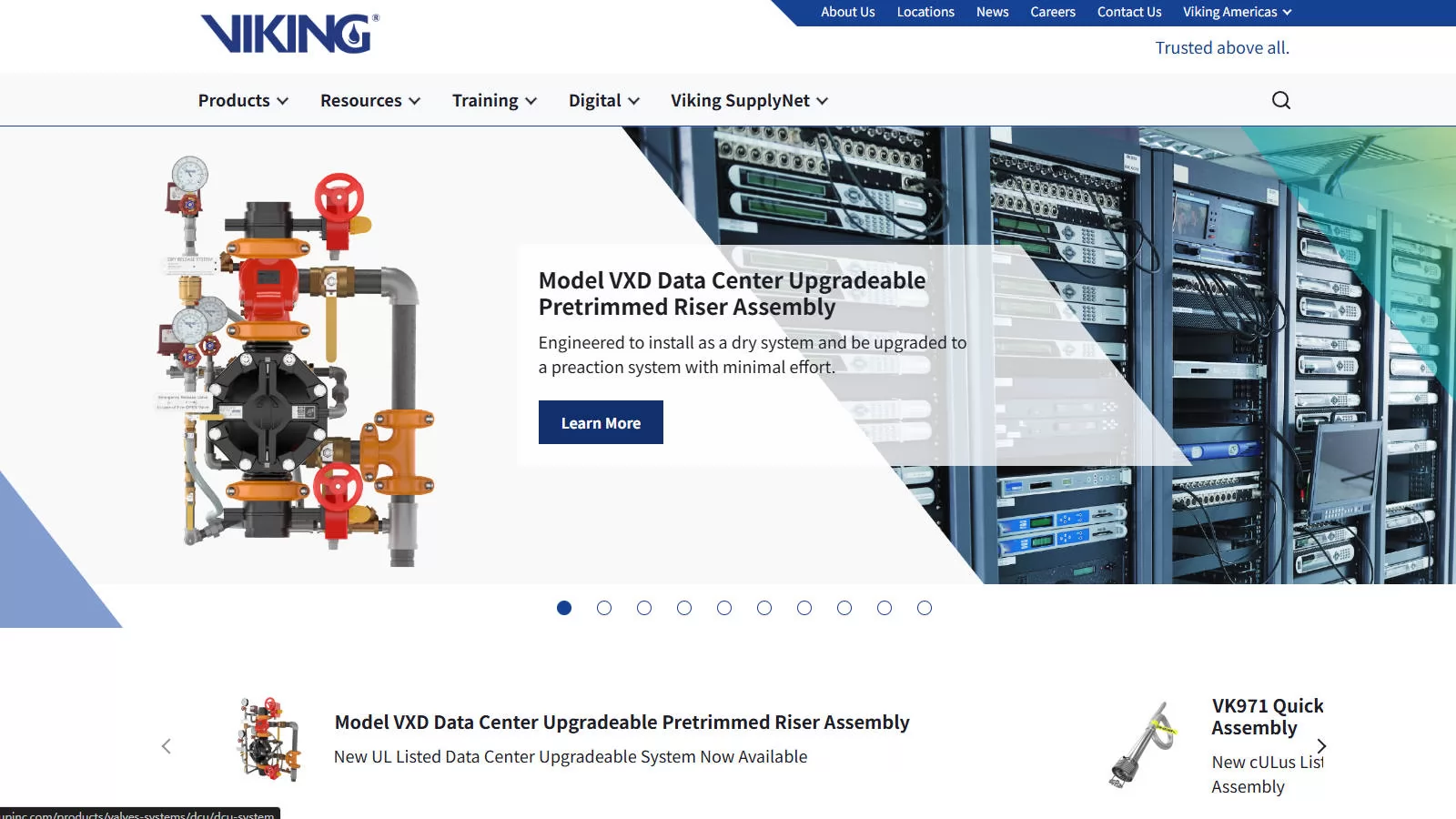
Supplier type: Manufacturer and distributor | HQ: Michigan, USA | Best for: code-compliant water-based components with predictable availability
Viking Group runs manufacturing and distribution together, which is less common than it sounds and genuinely useful. It produces sprinklers, valves, foam equipment and related components, then moves them through a distribution network reaching contractors and designers in many markets. For a project that needs approved water-based components without adding vendors, that combination shortens the supply chain.
Core products:
- Sprinklers, including extended coverage and storage types
- Wet and dry pipe valves and trim
- Foam system components
- Piping, fabrication and accessories
Verify before shortlisting: establish whether the specific model is manufactured by Viking or supplied through its distribution arm, and confirm the listing for the exact model, temperature rating and response type.
6. Amerex Corporation
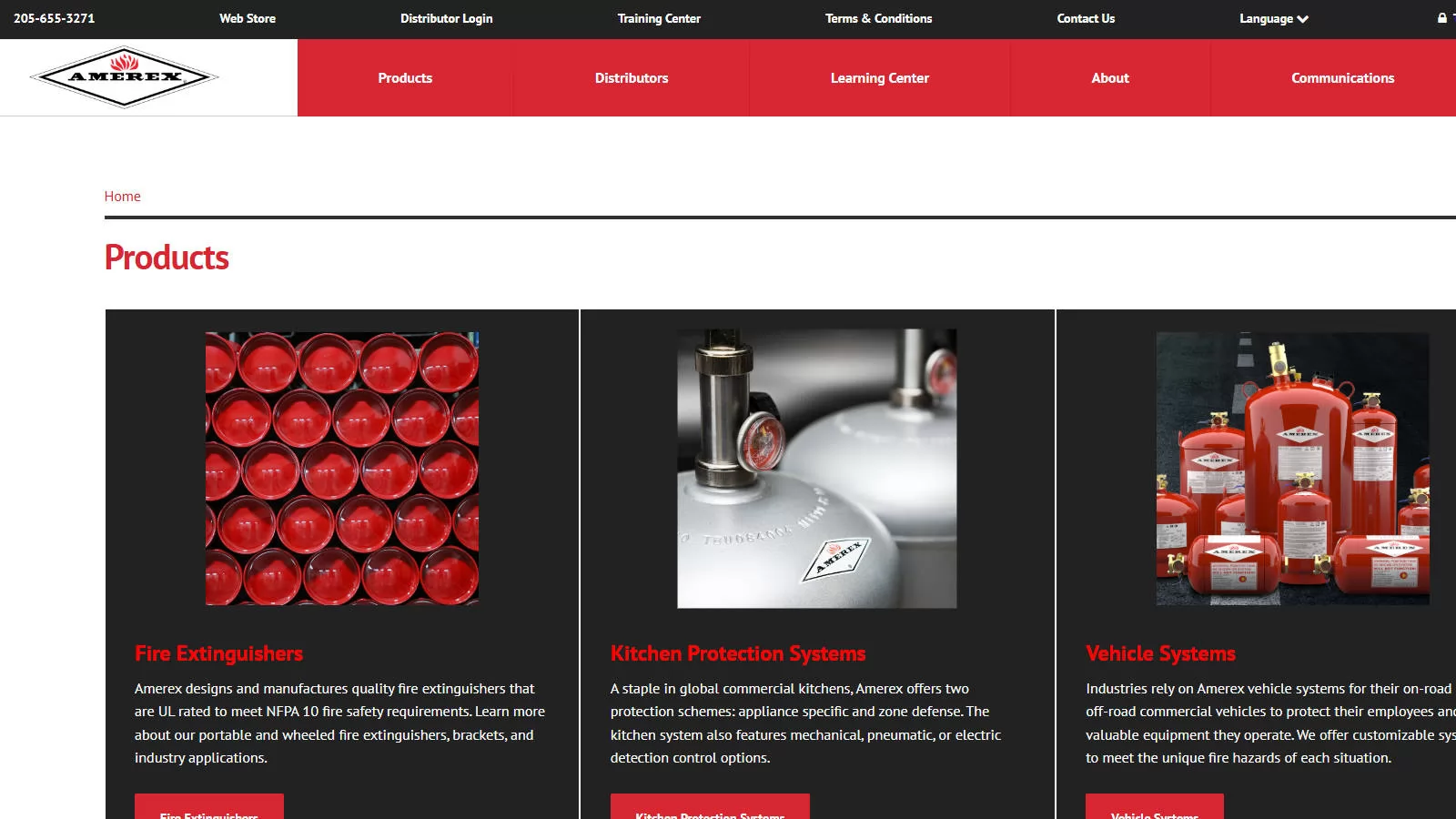
Supplier type: Manufacturer | HQ: Trussville, Alabama, USA | Best for: portable extinguishers and pre-engineered kitchen and vehicle systems
Amerex manufactures portable and wheeled extinguishers, pre-engineered kitchen suppression and vehicle systems. The range sits at the practical end of the market: equipment specified by model number, installed by a local distributor and serviced on a fixed schedule. For buyers standardising extinguishers across a site or a fleet, that simplicity is the main attraction, and the pre-engineered systems are a reasonable fit for repetitive layouts such as commercial kitchens.
Core products:
- Portable and wheeled extinguishers
- Kitchen hood suppression systems
- Vehicle suppression systems
- Industrial pre-engineered systems
Verify before shortlisting: confirm the listing that applies in your market, and check that the agent type and extinguisher class match the hazard rather than the nearest available model.
7. NAFFCO Group
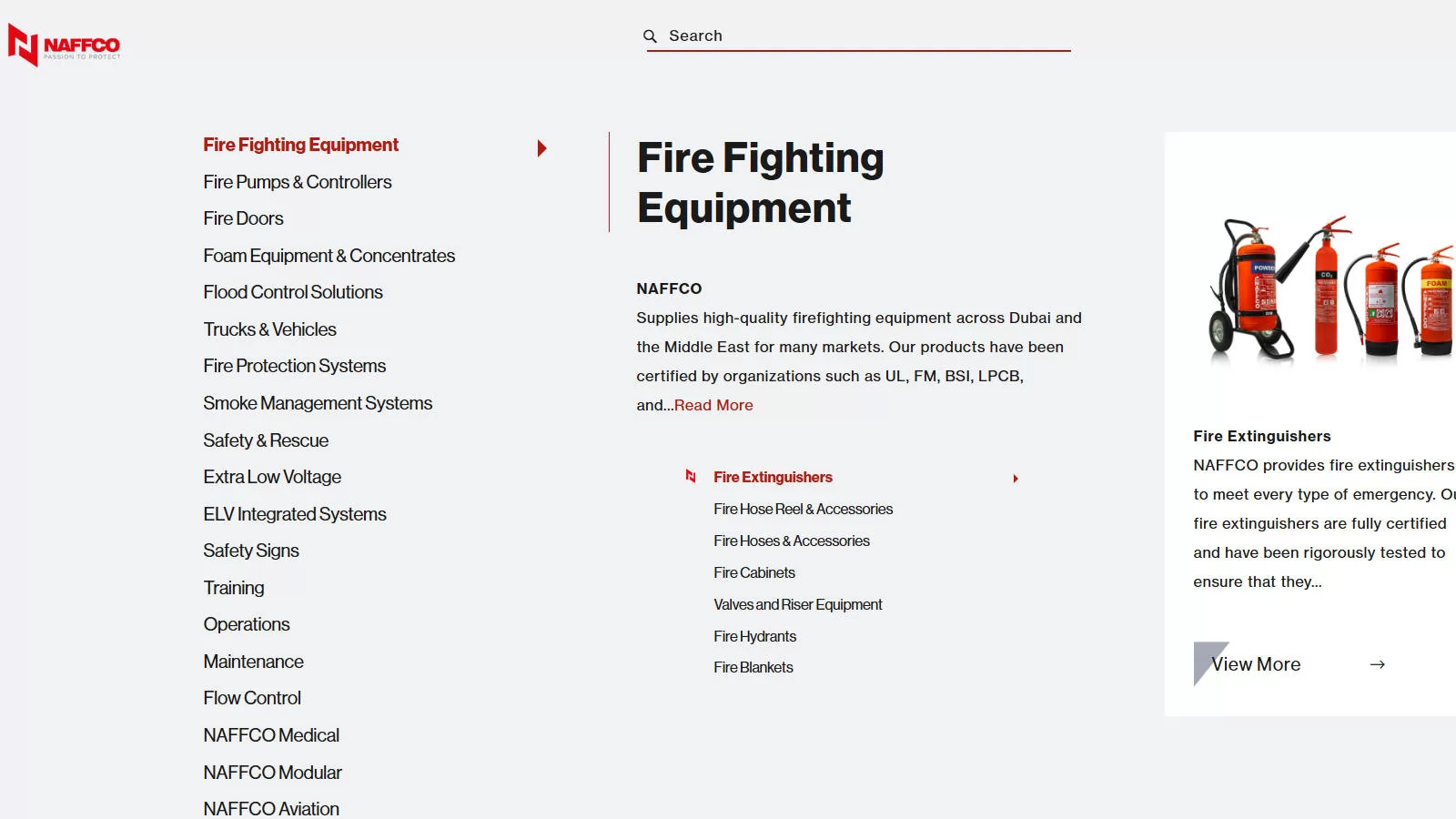
Supplier type: Manufacturer | HQ: Dubai, UAE | Best for: large multi-package projects that need one supplier across many product lines
NAFFCO manufactures across an unusually wide range: fire pumps and controllers, sprinkler and gas systems, foam equipment, extinguishers, alarm and detection, and emergency vehicles. That breadth is the point. On a large project split into several packages, one manufacturer covering pumps, systems and equipment reduces interface risk between subcontractors, provided the approvals hold in the destination market.
Core products:
- Fire pumps and controllers
- Sprinkler, gas and foam systems
- Extinguishers and hose equipment
- Alarm and detection systems
- Emergency and rescue vehicles
Verify before shortlisting: request the certification package per product line and per destination country. A wide catalogue does not guarantee that every item in it is approved where you are building.
8. Fire & Safety Equipment Company
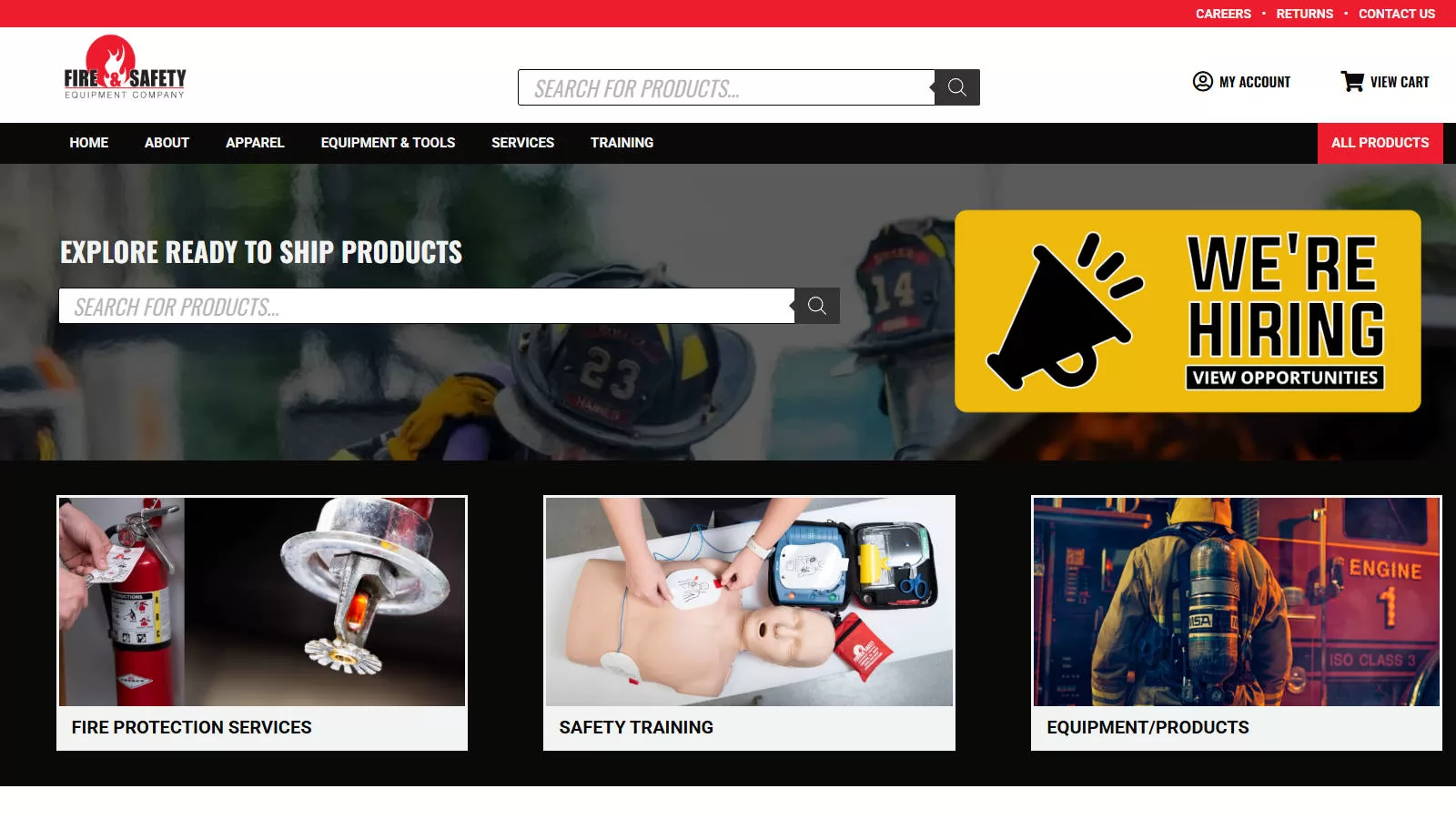
Supplier type: Regional distributor and service provider | HQ: Virginia, USA | Best for: local inspection, maintenance and compliance support
This is a regional business rather than a global manufacturer, and it is included because that is precisely what many buyers actually need. Fire & Safety Equipment Company supplies equipment, performs inspections and maintenance, and provides compliance training to schools, municipalities and industrial sites in its service area. If the requirement is ongoing service rather than a shipped product, a provider of this type is often the more useful answer than a large manufacturer.
Core services and products:
- Extinguisher inspection, service and recharge
- Suppression system inspection and maintenance
- Firefighting hand tools, hose and nozzles
- First aid supplies and compliance training
Verify before shortlisting: confirm the service area, technician certification and response time for scheduled and emergency call-outs. Outside its region, treat it as a benchmark for what a good local partner should provide rather than as a supply option.
9. Larsen’s Manufacturing
Supplier type: Manufacturer (enclosures) | HQ: Minnesota and Florida, USA | Best for: cabinets and enclosures that must satisfy architectural and code requirements
Larsen’s manufactures fire equipment cabinets and enclosures: extinguisher cabinets, hose and valve cabinets, blanket cabinets and brackets, supplied through a distributor network. The category is narrow, which is exactly why it deserves a place on the list. Cabinet specification is where projects quietly fail inspection, because recessed versus surface mounting, glass type, signage and clearance are all code items rather than finish choices.
Core products:
- Fire extinguisher cabinets and brackets
- Fire hose and valve cabinets
- Fire blanket cabinets
- Custom and architectural enclosures
Verify before shortlisting: match the cabinet model to the mounting condition and the local code, and confirm delivered dimensions against the wall opening before fabrication begins.
10. Firetrace International
Supplier type: Manufacturer (special-hazard suppression) | HQ: Scottsdale, Arizona, USA (part of Halma plc) | Best for: automatic detection and suppression for high-risk equipment and enclosed spaces
Firetrace, part of Halma, makes self-contained detection and suppression systems for enclosed equipment: electrical panels, machine tools, wind turbine nacelles, vehicle engine bays and similar spaces. The system uses pressurised detection tubing that ruptures at the hottest point and releases agent directly at the source, without needing a detection panel or power supply. It answers a specific problem well, and it is not a substitute for building protection.
Core products:
- Direct release systems
- Indirect release systems
- Detection tubing and system accessories
- Agent options that vary by model and application
Verify before shortlisting: check the maximum enclosure volume and tubing run for the chosen model, confirm which agents are currently available for that model rather than assuming the full historical range, and establish that the agent suits the equipment’s likely ignition source and energised state.
Comparison of the 10 Listed Suppliers and JUAND
The table below separates the companies by supplier type and core focus. Read the type column first, then the last column: the type tells you whether two suppliers can be compared on price at all, and the best-fit column tells you which one to contact for a given requirement. JUAND appears as an additional reference for industrial special-hazard work in the section below; it is not one of the ten suppliers listed above and is not numbered.
| Supplier | HQ | Supplier type | Core focus | Best-fit buyer or project |
|---|---|---|---|---|
| Allstar Fire Equipment | USA (CA) | Distributor | Extinguishers, hose, station equipment | Standard equipment and consumables sourced quickly within the US |
| Minimax GmbH | Germany | Manufacturer / integrator | Sprinkler, gas, detection | Projects that need design, installation and maintenance from one party |
| Marioff Corporation | Finland | Manufacturer | Water mist (HI-FOG) | Hazards where water volume, weight or clean-up cost is the constraint, subject to application-specific testing |
| Rosenbauer International | Austria | Manufacturer (vehicles and systems) | Vehicles, pumps, vehicle-mounted systems | Vehicle fleets, airport rescue and mobile suppression equipment |
| Viking Group | USA (MI) | Manufacturer + distributor | Sprinklers, valves, foam | Water-based components with predictable availability |
| Amerex Corporation | USA (AL) | Manufacturer | Extinguishers, kitchen and vehicle systems | Standard extinguisher fleets and pre-engineered kitchen or vehicle protection |
| NAFFCO Group | UAE | Manufacturer | Pumps, systems, vehicles, alarms | Large projects buying several product categories from one supplier |
| Fire & Safety Equipment Co. | USA (VA) | Distributor / service provider | Inspection, maintenance, equipment supply | Ongoing service and compliance support within its region |
| Larsen’s Manufacturing | USA (MN / FL) | Manufacturer | Cabinets and enclosures | Architectural equipment housing that must pass inspection |
| Firetrace International | USA (AZ) | Manufacturer (special hazard) | Enclosure detection and suppression | Protection inside electrical panels, machines and engine bays |
| JUAND (Guo Anda) | China | Manufacturer | CAFS, dry powder, BESS and vehicle systems | Industrial special-hazard projects inside its certified product range |
How to Choose the Right Fire Safety Equipment Supplier
Choosing between suppliers is mostly a documentation exercise, not a sales conversation. Five checks resolve most of the uncertainty.
1. Decide whether you are buying a product, a system or a service. A product is specified by model and delivered against a purchase order. A system includes design responsibility, installation and commissioning, and the supplier carries performance risk. A service is a recurring inspection and maintenance contract. Mixing these into one comparison is the most common sourcing mistake in this category.
2. Verify the approval, not the logo. A manufacturer’s marketing page may list several certifications while the certificate itself covers one model or one configuration. Certification and approval requirements depend on the product category, the intended application and the destination market, so no single mark covers everything on this list. Ask the supplier for the certificate or listing that covers the exact model and configuration, verify its current validity with the issuing body, and confirm any additional requirement imposed by the local authority or the project specification. In China, mandatory certification and market access are also applied per product category, so the scope has to be checked rather than assumed.
3. Ask who actually manufactures. For imported equipment, request the factory address, the model numbering convention and an OEM disclosure statement. A supplier that assembles from third-party components is not a problem, provided the components and their approvals are disclosed. It becomes a problem when the system is sold as a single-party design and turns out to be a kit.
4. Check the support model after commissioning. Ask for the nearest service branch, typical technician response time, spare parts lead time, warranty duration and what voids it, and whether operator training is included. This section decides the real cost of ownership far more than unit price.
5. Plan export and logistics early. Pressurised cylinders are dangerous goods: they need UN numbers, SDS documentation, correct packing and a freight forwarder that accepts them. Some extinguishing agents also carry shelf-life and refill constraints that affect multi-year projects. Agree Incoterms and the responsible party for import clearance before the technical evaluation closes, not after.
Why Consider JUAND for Industrial Fire Protection

JUAND, also known as Guo Anda, occupies a narrower position than most companies on this list. It does not compete across every category above. Its focus is automatic suppression for hazards located inside equipment and infrastructure: substations and converter stations in power transmission, vehicle engine and battery compartments, and lithium-ion battery storage cabinets and containers.
That narrower scope is both the reason to evaluate it and the limit of the comparison. For a building sprinkler package or a fleet of portable extinguishers, the manufacturers earlier in this list are the better answer. For a fixed automatic system protecting an energised asset with limited maintenance access, the requirement changes: detection inside the enclosure, suppression at pack or compartment level, and hardware that tolerates heat, vibration and long service intervals.
The company was established in Xiamen in 2008 and has been listed on the Shenzhen Stock Exchange since 2020. It has operated a dedicated electrochemical energy storage safety business unit since 2022.
Product areas relevant to industrial buyers:
- Compressed air foam (CAFS) systems for large oil-filled equipment such as transformers, where water alone is ineffective and foam runoff must be controlled.
- Ultra-fine dry powder automatic devices for electrical cabinets, cable trenches and confined technical spaces.
- BESS fire protection at pack and container level, including early detection and long-duration suppression for thermal runaway.
- Vehicle cabin and battery compartment systems for electric buses, coaches and commercial fleets.
Treat JUAND the way this article asks you to treat every other supplier here: request model-level test reports and certificates for your destination market, drawings, agent data sheets and, where the order size justifies it, a factory audit. Certification scope and service arrangements decide whether the project succeeds, and no product page replaces that check.
The full range is on the JUAND products page, and technical requirements can be sent directly through contact.

Fire Safety of Power Grid

Fire Safety of Transportation

Fire Safety of BESS

Fire Safety of Low Altitude Area
FAQs
Should I buy fire safety equipment from a manufacturer or a distributor?
Buy from a manufacturer when the requirement involves design, custom configuration or system performance risk. Buy from a distributor when the specification is fixed, the item is a standard product, and delivery speed or local stock matters more than engineering support.
How do I confirm a supplier’s certificate is valid in my country?
Ask for the certificate number and read the scope: product, model, size and application. Then check the issuing body’s public register for its current status. A certificate issued for one market is not automatically accepted in another, and local authority approval may be required in addition.
What is the difference between fire safety equipment and a fire suppression system?
Equipment is a discrete product, such as an extinguisher, hose, cabinet or detector. A suppression system combines detection, control and agent release, and is designed for a defined hazard. The two are procured differently and usually from different suppliers.
Can automatic suppression systems be sourced directly from a Chinese manufacturer?
Yes, and it is common for industrial projects. The practical requirements are model-level test documentation, destination-market certification or acceptance, an SDS for the extinguishing agent, and a clear agreement on commissioning support and spare parts.
Do I need a local partner if I import the equipment?
For portable equipment, usually only for scheduled servicing and recharge. For fixed automatic systems, a local partner is close to essential: cylinder hydrostatic testing, agent refill and periodic inspection are regulated activities, and shipping hardware back to the factory is rarely practical.
Conclusion
The ten suppliers above cover different jobs: distribution, engineered systems, water mist, vehicles, water-based components, portable equipment, detection and alarm, enclosures, and special-hazard suppression. None of them is the right answer for every project, and a shortlist that mixes them without checking supplier type will produce quotes that cannot be compared.
Start with the hazard, then the supplier type, then the approval scope. Price comes last, because it is the only variable that cannot be corrected after installation.
Need an Industrial Fire Suppression Solution?
If you are evaluating fire protection for power grid equipment, transportation systems, or battery energy storage, contact JUAND with your application, hazard profile, and project requirements. Its technical team can help you assess suitable product options and the documentation needed for your market.
Contact JUAND to discuss your project.

