
Types of Fixed Fire Extinguishing Systems: How to Choose the Right Solution
Fire hazards in modern industrial, commercial, and energy infrastructure environments present severe, multifaceted risks to personnel safety, high-value structural assets, and overall operational continuity. The potential for catastrophic loss—ranging from irreversible equipment damage and severe regulatory non-compliance to costly operational downtime and the ultimate threat to human life—demands a proactive, uncompromising approach to fire safety engineering. Unlike portable fire extinguishers, which rely entirely on immediate manual operation, human presence, and localized physical accessibility during a crisis, a fixed fire extinguishing system offers an automated, highly reliable, and round-the-clock defense mechanism designed to neutralize threats instantaneously at their earliest detectable stage.
These sophisticated engineering solutions are permanently integrated into a facility's structural infrastructure, built directly into compact equipment enclosures, or mounted onto specialized heavy machinery. By utilizing advanced sensor arrays, continuous thermal monitoring networks, and rapid-response automated discharge valves, a modern fixed fire suppression system is engineered to detect critical thermal anomalies or the presence of smoke and flammable vapors long before open flames become visible. Upon threat verification, the system instantly initiates the precise release of the appropriate extinguishing agent, completely eliminating the requirement for high-risk human intervention within hazardous, high-temperature zones. This automated precision ensures uninterrupted business operations, minimizes secondary collateral damage, and guarantees maximum protection for mission-critical industrial assets.
What Is a Fixed Fire Extinguishing System?
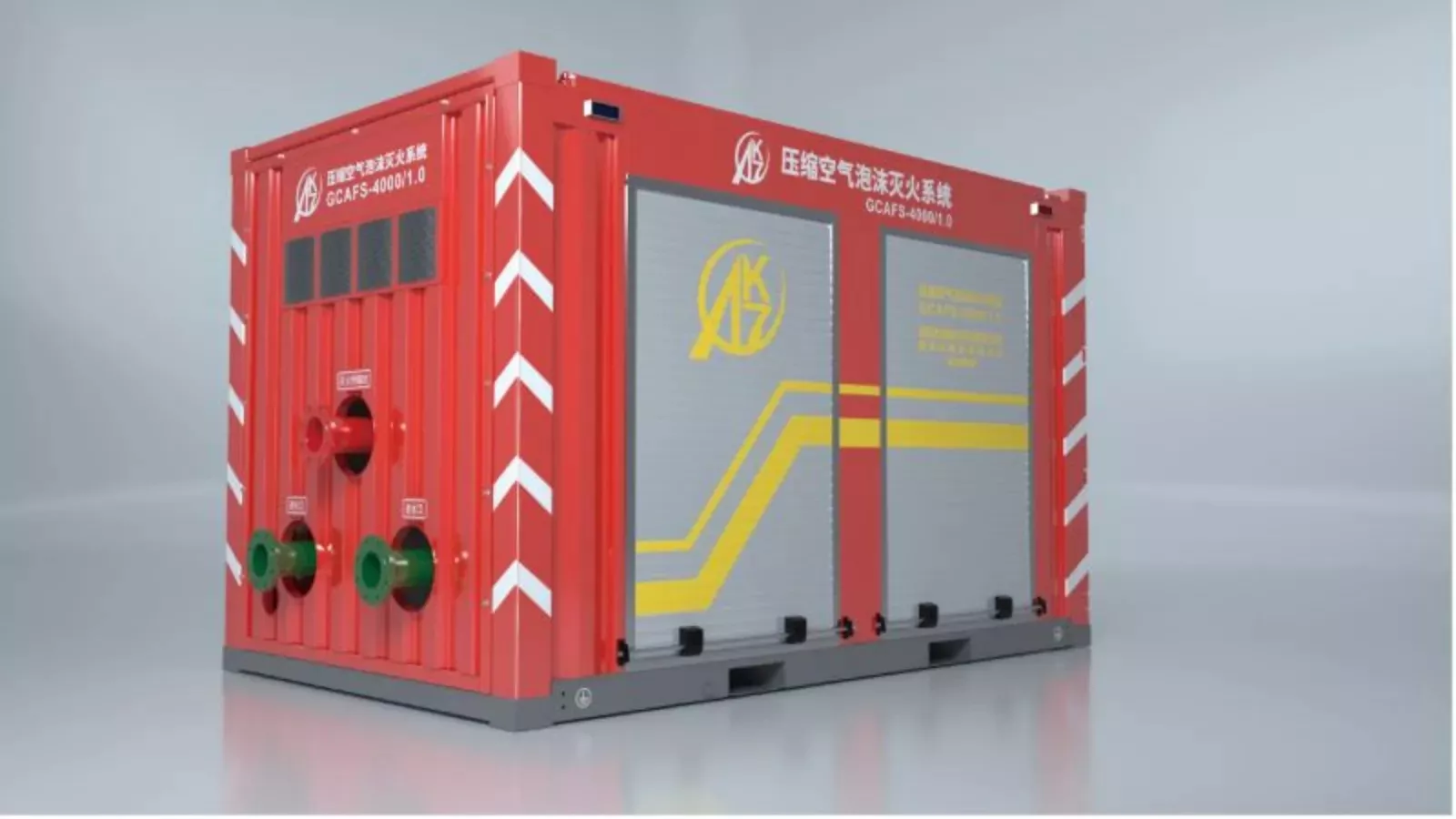
A fixed fire extinguishing system (also referred to as a fixed fire suppression system) is an engineered safety solution permanently integrated into a facility's structural infrastructure, built directly into compact equipment enclosures, or mounted onto specialized heavy machinery. These systems are precisely designed to detect, contain, and completely extinguish fires at their earliest incipient stages, eliminating the need for high-risk human intervention in hazardous, high-temperature zones.
For facility managers, engineering, procurement, and construction (EPC) contractors, and industrial safety engineers, selecting the correct fixed fire suppression architecture is not merely a routine compliance check—it is a critical engineering decision that dictates the survival of the facility during a crisis. Choosing an incompatible suppression agent, an inadequate discharge layout, or an inappropriate detection mechanism can lead to irreversible equipment damage, catastrophic downtime, severe regulatory non-compliance, and potential loss of life.
The Critical Importance of Automated Fire Suppression
The landscape of industrial fire safety has evolved dramatically from simple localized water deluge systems to highly intelligent, sensor-driven suppression networks. In today’s high-stakes industrial environments, the window of time between ignition and uncontrollable conflagration is measured in mere seconds. Automated manufacturing equipment running continuous twenty-four-hour cycles, densely packed lithium-ion battery energy storage systems (BESS), and high-voltage power grids operate under immense thermal and electrical stress. These environments are often unmanned, meaning that relying on manual fire discovery practically guarantees a total loss event.
A properly designed fixed fire extinguishing system bridges this vulnerability gap by offering several critical functions:
- Continuous Anomaly Detection: Utilizing advanced optical flame detectors, air-sampling smoke detectors (VESDA), and linear heat-sensing cables to identify thermal anomalies long before open flames become visible.
- Instantaneous Actuation: Discharging the appropriate extinguishing agent within milliseconds of verifying the threat to suppress the flame right at its origin.
- Automated Environmental Isolation: Synchronizing with facility management systems to shut down mechanical ventilation, close fire dampers, isolate electrical supply lines, and signal emergency response teams automatically.
5 Main Types of Fixed Fire Extinguishing Systems
Fixed fire extinguishing systems are fundamentally classified by the specific suppression agent they deploy into the hazard zone. Each agent possesses entirely distinct physical properties, chemical mechanisms, and operational limitations. Understanding how these chemical agents and physical compounds interact with the classic fire triangle (heat, fuel, oxygen, and chemical reaction) is the foundational step in successful system design.
1. Clean Agent Gas Suppression Systems (FM-200, FK-5-1-12, Inert Gases)
Clean agent suppression systems utilize engineered gaseous chemical compounds (such as FK-5-1-12 and HFC-227ea/FM-200) or naturally occurring inert gas mixtures (such as Nitrogen, Argon, and IG-541) to extinguish fires without leaving any liquid, solid, or particulate residue behind.
- Suppression Mechanism: Synthetic chemical agents extinguish fires primarily through rapid, intense heat absorption at the molecular level, breaking the chemical chain reaction of combustion. Inert gas systems work by rapidly lowering the ambient oxygen concentration within a sealed space from 21% down to below 15%—a level where fire cannot burn, but humans can still safely breathe during evacuation.
- Electrically Non-Conductive: Completely safe to deploy directly onto energized high-voltage equipment and sensitive electronics without causing short circuits.
- Zero Post-Fire Residue: Eliminates post-fire cleanup, brilliantly protecting delicate server racks, historical archives, and precision electronics from secondary liquid damage.
- Rapid Suppression: Designed to achieve full discharge within 10 seconds of activation.
- System Limitations: Requires a highly sealed room (total flooding environment) to maintain the required gas concentration over a specified hold time. Unsuitable for open or heavily ventilated industrial floors.
2. High-Pressure Water Mist Systems
While traditional water sprinklers remain the historical standard for general commercial buildings, advanced high-pressure water mist systems have completely revolutionized heavy industrial fire safety by minimizing water usage while maximizing cooling and displacement efficiency.
- Suppression Mechanism: Heavy-duty positive displacement pumps force pure, filtered water through specialized micro-nozzles at immense pressures (often exceeding 80 to 100 bar). This creates droplets smaller than 100 microns, generating a massive surface area that absorbs radiant heat rapidly. As these fine droplets convert into steam, they expand 1,700 times in volume, naturally displacing oxygen right at the fire core.
- Exceptional Cooling Capacity: Absorbs heat far more aggressively than standard deluge sprinklers.
- Drastically Reduced Water Damage: Uses up to 80% less water than traditional sprinklers, minimizing structural water damage and reducing contaminated wastewater runoff.
- Eco-Friendly: Uses 100% pure water without chemical additives or global warming potential.
- System Limitations: Introduces moisture into the atmosphere, which requires careful engineering isolation before deployment near unsealed live high-voltage components.
3. Automatic Aerosol and Superfine Powder Systems
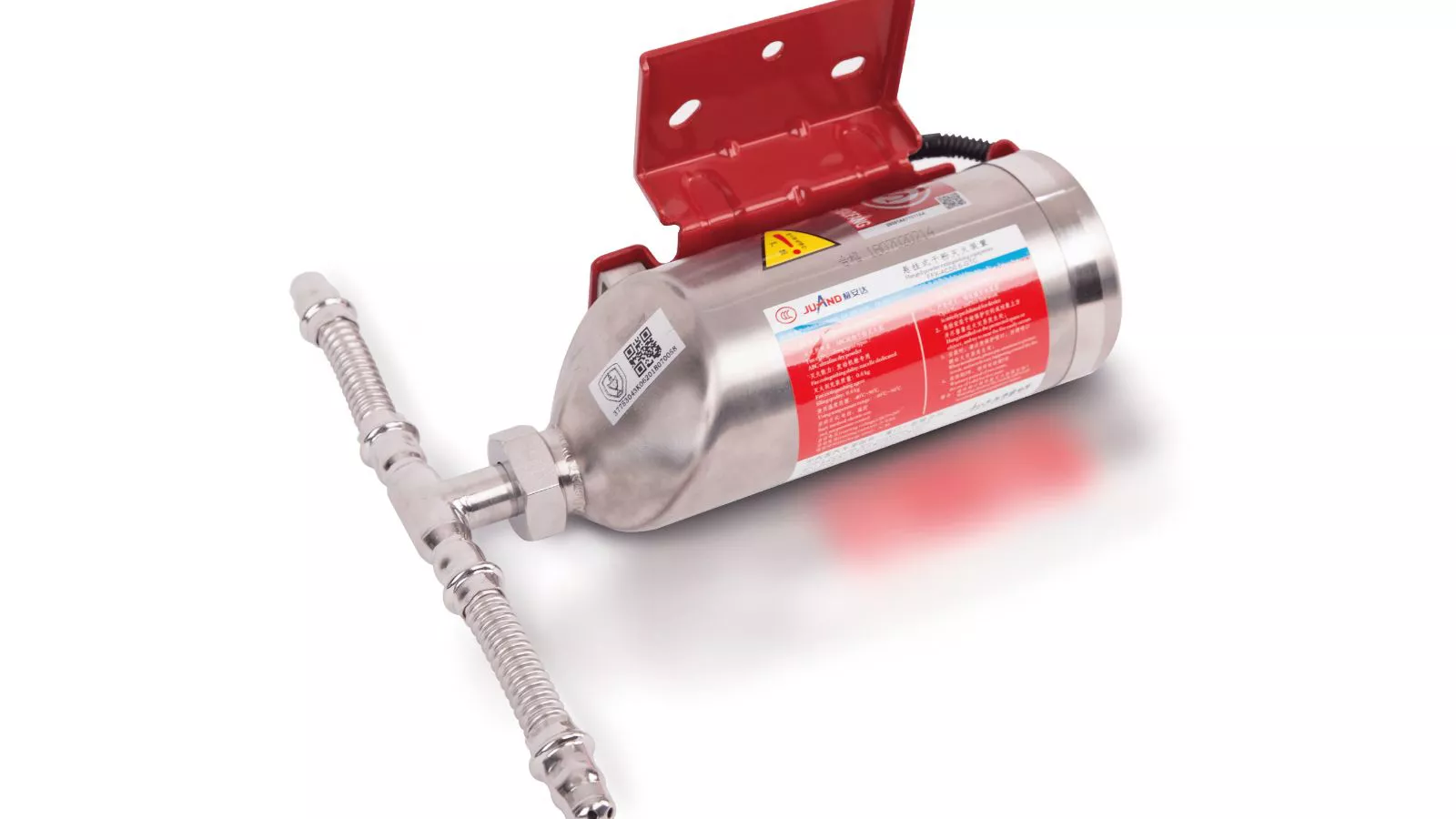
Aerosol and superfine dry powder systems represent a highly efficient, space-saving class of fire suppression explicitly designed for compact enclosures and localized hazards where traditional piping infrastructure is impossible or cost-prohibitive.
- Suppression Mechanism: Solid aerosol generators undergo a rapid thermo-chemical reaction to produce ultra-fine solid potassium-based particles suspended in an inert gas matrix. Superfine dry powder systems utilize micro-sized chemical salts (such as ammonium phosphate) propelled by stored pressure or thermal actuators. Both mechanisms physically and chemically interfere with free radicals in the flame, breaking the combustion chain reaction.
- Ultra-Compact Footprint: Completely eliminates the need for extensive pipe networks, complex distribution manifolds, or heavy pressurized cylinder storage rooms.
- Cost-Effective Retrofitting: Extremely easy to install inside narrow spaces, pre-existing electrical cabinets, or containerized modules.
- High Extinguishing Efficiency: Exceptional mass-to-volume extinguishing ratio, knocking down fires within seconds.
-
System Limitations: Leaves a fine layer of chemical dust post-discharge that requires mechanical cleanup before electrical equipment can be safely re-energized.
4. Compressed Air Foam Systems (CAFS) & Advanced Foam Systems
Foam suppression systems combine water, a specialized chemical foam concentrate, and air to create a heavy, sticky blanket over volatile liquid fuel fires. Compressed Air Foam Systems (CAFS) elevate this technology by mechanically introducing high-pressure air directly into the foam-water solution inside the pipe manifold before discharge.
- Suppression Mechanism: CAFS generates a dense, highly uniform bubble structure with high kinetic energy and stability. The heavy foam blanket aggressively smothers the burning liquid fuel surface, cutting off the oxygen supply while acting as a thermal insulator to prevent flammable liquid vapors from re-igniting.
- Superior Burn-Back Resistance: Prevents extreme heat from vaporizing underlying liquid fuels and stops catastrophic re-ignition.
- High Expansion Coverage: Capable of clinging to vertical surfaces and covering massive horizontal liquid fuel spills rapidly.
- Reduced Water Usage: Provides higher suppression efficiency per liter of water compared to standard foam-water deluge systems.
- System Limitations: Requires post-discharge foam cleanup, environmental wastewater containment protocols, and is generally unsuitable for sensitive, unsealed electronics.
5. Carbon Dioxide (CO2) Systems (High & Low Pressure)
Carbon dioxide is a deeply established, traditional gaseous suppression agent that has been heavily utilized in massive, unpopulated industrial manufacturing spaces for decades.
- Suppression Mechanism: Discharged rapidly as a heavy, freezing-cold gas that actively suffocates the fire by heavily diluting the ambient oxygen concentration in the hazard area from 21% down to lethal levels (typically below 15%).
- Cost-Effective & Non-Conductive: Highly economical, globally available, non-conductive, and leaves zero residue to clean up.
- Immediate Hazard to Human Life: Carbon dioxide concentrations required for fire suppression are lethal to humans due to rapid asphyxiation. Systems require mandatory, audited pre-discharge delay alarms, pneumatic sirens, and fail-safe lock-out valves.
- System Limitations: Strictly restricted to unpopulated or fully enclosed industrial spaces, including power generator rooms, deep industrial dip tanks, and automated metal processing units.
System Architecture: Total Flooding vs. Localized Protection
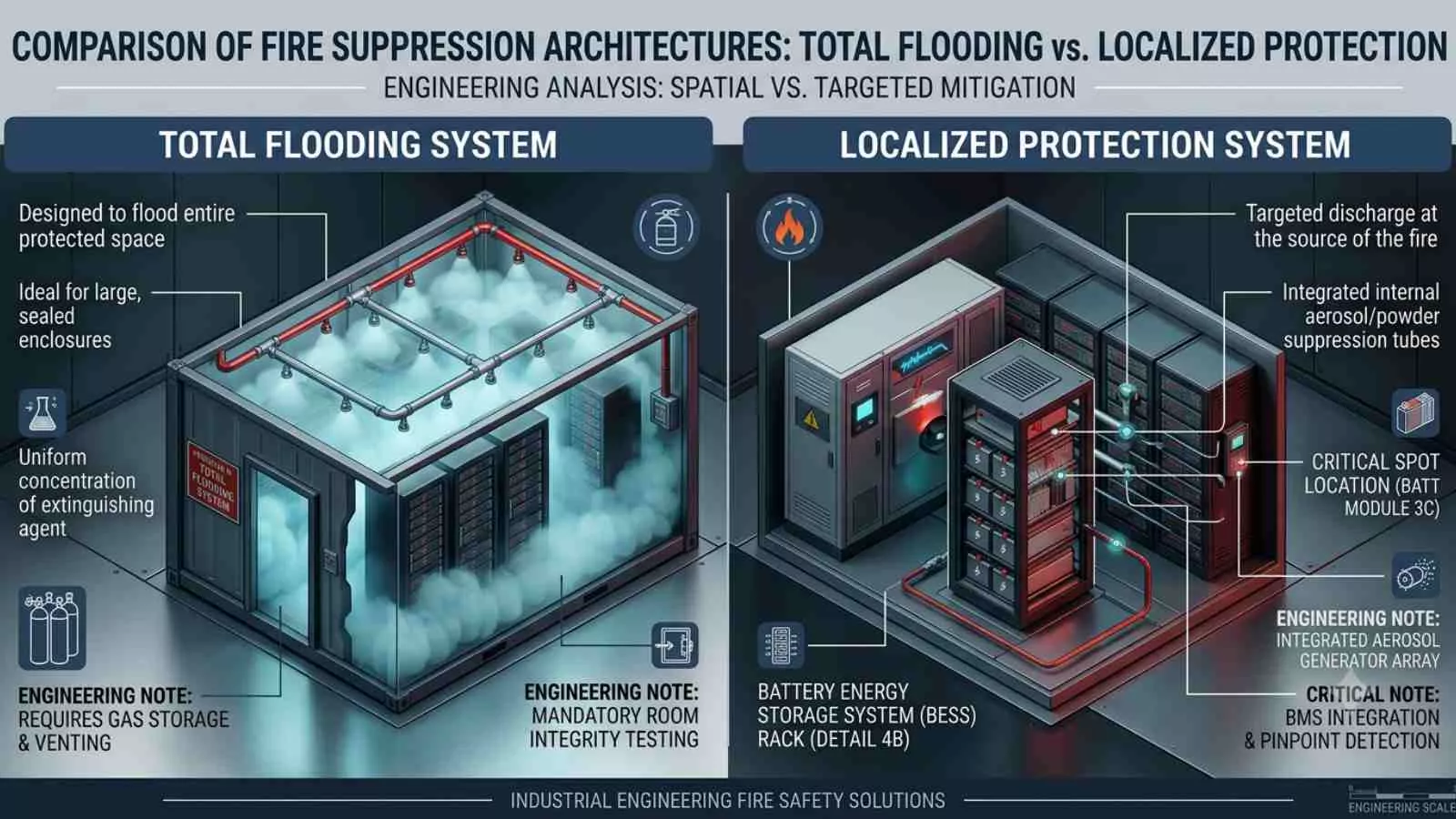
Beyond selecting the appropriate chemical or physical extinguishing agent, structural safety engineers must determine the physical architecture of the fixed fire extinguishing system. This generally falls into two distinct operational categories:
Total Flooding Systems
Total flooding systems are designed to discharge a precise volume of the suppression agent throughout an entire enclosed room or compartment to reach a uniform concentration level from floor to ceiling. This architecture ensures that hidden, deep-seated fire sources—such as flames creeping behind server racks, sub-floor cable trenches, or complex machinery—are thoroughly extinguished. Implementing a total flooding system requires strict structural enclosure integrity, auto-closing mechanical ventilation dampers, and sealed cable penetrations to prevent agent leakage during the mandatory hold time.
Localized (Direct-to-Hazard) Protection Configurations
Localized suppression systems are engineered to target strictly high-risk components within a much larger, potentially ventilated or unsealed industrial space. This direct-to-hazard approach provides instantaneous fire detection and suppression at the exact point of origin—often before external facility alarms even register a threat, preventing a minor component failure from escalating into a full-scale facility fire. These configurations utilize direct-to-hazard mechanisms, such as pneumatic thermal sensing tubes routed inside a CNC machine enclosure or self-contained aerosol devices bolted inside a specific battery rack.
How to Choose the Right Solution: Strategic Decision Matrix
To navigate the complexities of fixed fire extinguishing systems, decision-makers should evaluate their facilities against international hazard classifications, asset financial sensitivity, physical space constraints, and environmental compliance standards.
| System / Agent Type | Electrical Non-Conductivity | Post-Fire Residue | Installation Footprint | Ideal Hazard Class | Primary Industrial Applications |
|---|---|---|---|---|---|
| Clean Agent Gas | Excellent | None | Large (Cylinders & Pipework) | Class A, B, C | Data centers, telecom hubs, control rooms |
| High-Pressure Water Mist | Moderate | Low (Pure water) | Medium (Pumps & Water Storage) | Class A, B | Marine engine rooms, cable tunnels, turbines |
| Superfine Powder / Aerosol | Excellent | Moderate (Fine dust) | Ultra-Compact (Self-contained) | Class A, B, C, D | BESS cabinets, electrical panels, vehicle engines |
| CAFS / Advanced Foam | Limited | High (Foam blanket) | Medium to Large | Class B Hydrocarbons | Power transformers, fuel depots, logistics hubs |
| Carbon Dioxide (CO2) | Excellent | None | Large (Cylinders & Pipework) | Class B, C (Unoccupied) | Unoccupied power plants, metal processing |
Key factors to evaluate during system procurement:
- Specific hazard classification present (Class A solid combustibles, Class B liquid hydrocarbons, Class C electrical risks, or Class D metal/battery risks).
- Financial impact of post-fire agent cleanup versus immediate operational continuity requirements.
- Structural room enclosure integrity and ventilation conditions.
- Physical space availability for dedicated storage cylinders versus self-contained modular units.
- International compliance requirements (NFPA 2001, NFPA 750, NFPA 11, ISO 15779, CE, and UL certifications).
High-Risk Industrial Applications & Engineering Solutions
Modern industrial fire protection demands customized engineering solutions tailored to specific operational realities. General off-the-shelf commercial retail systems often fail when exposed to the intense vibration, harsh dust, and thermal stress of heavy industrial environments. Backed by extensive research and over 200 patented technologies, JUAND provides tailored fixed suppression solutions across critical industrial sectors:
- Battery Energy Storage Systems (BESS) & Lithium-Ion Protection: Grid-scale lithium-ion battery enclosures present severe thermal runaway risks. JUAND recommends a multi-stage suppression strategy combining cabinet/pack-level localized detection (superfine powder or aerosol) to knock down the initial chemical flame, coupled with container-wide secondary cooling (CAFS or water mist) to absorb heat, prevent thermal propagation, and eliminate gas re-ignition risks.
- Power Grids and Heavy Electrical Substations: High-voltage oil-immersed transformers and switchgear rooms strictly require non-conductive, dielectric systems. Specialized dry powder configurations or finely tuned CAFS designs provide rapid localized cooling, high dielectric insulation, and a long-range fire blanket application that safely smothers boiling transformer oil fires from a safe physical distance.
- Commercial Transportation & Mining Fleets: Heavy machinery, transit buses, and mining fleets operate under constant high vibration and severe ambient temperature fluctuations. JUAND provides pre-engineered, vibration-resistant automatic pipeline superfine powder units and compact aerosol devices that activate automatically during engine bay thermal surges without requiring external electrical power.
- Automated Manufacturing & CNC Machinery: Multi-axis CNC machines utilizing combustible hydraulic fluids require localized chassis protection. Installing autonomous pneumatic detection tubes with superfine powder cylinders suppresses internal fires within seconds, protecting multimillion-dollar assets without halting adjacent production lines.
Maintenance & International Compliance Standards
Deploying a fixed fire extinguishing system requires strict adherence to global engineering codes to guarantee system actuation during a fire emergency. Standard compliance requirements include:
- NFPA 2001: Standard on Clean Agent Fire Extinguishing Systems.
- NFPA 750: Standard on Water Mist Fire Protection Systems.
- NFPA 11 / NFPA 16: Standards for Low/Medium/High-Expansion Foam and Foam-Water Sprinkler Systems.
- ISO 15779: Condensed aerosol fire extinguishing systems requirements.
Routine Maintenance Protocol:
- Quarterly: Inspect cylinder pressure gauges, thermal sensors, manual release buttons, and control panel status indicators.
- Semi-Annually: Check agent cylinder weights, test detector loop continuity, and verify automatic damper actuation.
- Annually: Perform full system functional testing, enclosure integrity leakage testing (for total flooding gas systems), and discharge nozzle clearance inspections.
Why Choose JUAND for Fixed Fire Extinguishing Systems?
Selecting the correct fixed fire extinguishing system is critical for industrial safety and business continuity. With deep expertise in complex fire behaviors and advanced engineering capabilities, JUAND delivers high-performance fixed suppression systems trusted across global industries. Our solutions combine rigorous research, patented technologies, and strict quality standards to ensure maximum fire protection.
- 16+ Years of Industrial Fire Research: Extensive experience in understanding and mitigating fire risks in petrochemical, energy, manufacturing, and logistics facilities.
- 11 Years of Lithium-Ion Battery Fire Research: Specialized expertise enabling JUAND to engineer fixed suppression solutions suitable for emerging risks such as BESS and EV battery-related fires.
- 400+ Member Professional Team: A multidisciplinary team supporting product design, testing, engineering, and technical service.
- 18+ Major Research Projects: In-depth participation in national and industry-level fire protection research initiatives.
- 50+ Standards & Codes Contributions: Active involvement in developing fire protection standards, ensuring JUAND solutions meet the highest safety requirements.
- 40+ Science & Technology Awards: Recognition for innovation, performance, and contributions to industrial fire safety.
-
200+ Patented Technologies: Proprietary designs that enhance the efficiency, reliability, and intelligence of JUAND fixed fire suppression systems.
Conclusion
Selecting and integrating the correct fixed fire extinguishing system is rarely a simple purchasing decision; it requires deeply balancing thermodynamic hazard types, localized asset vulnerability, facility physical footprints, and extraordinarily strict regulatory compliance standards. By combining early fire detection, optimal extinguishing agent selection, and reliable actuation architectures, fixed fire systems offer rapid and dependable fire control solutions for high-risk industrial environments.
With JUAND’s 16+ years of industrial fire research, specialized lithium-ion battery fire expertise, and over 200 patented technologies, businesses can trust in highly engineered fixed fire suppression solutions tailored to meet complex fire protection needs. For facility managers and safety engineers seeking custom system design, comprehensive hazard assessments, and ongoing technical support, Contact JUAND today to learn how our fixed fire extinguishing solutions can safeguard your operations and protect lives.

